Don’t Choose the Wrong Yeast: Low-Sugar vs High-Sugar Yeast Complete Breakdown
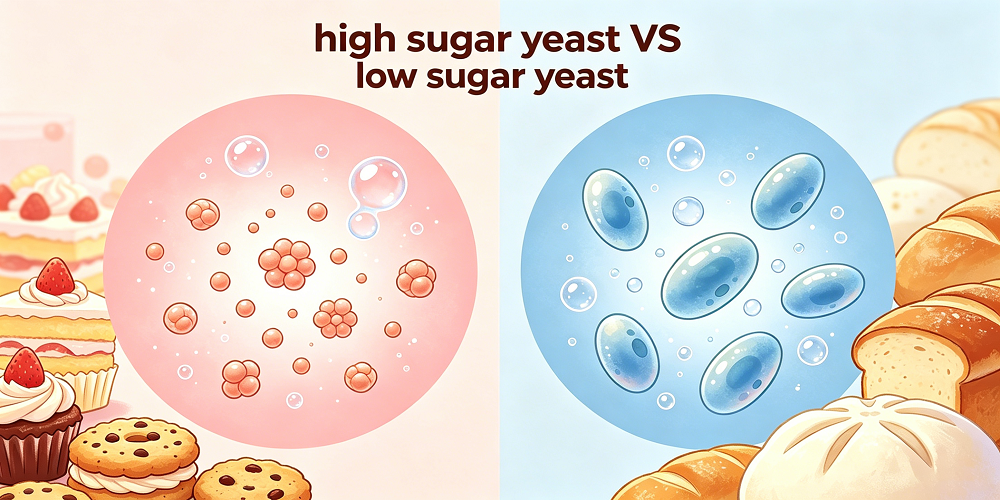
For bakery manufacturers and distributors, yeast compatibility with dough sugar content is a critical factor affecting production stability. Standard low-sugar yeast thrives in formulas with 0–7% sugar, while high-sugar yeast is custom-made to endure sugar levels above 7%. Utilizing the incorrect yeast strain will lead to prolonged fermentation cycles, weird flavors, and collapsed dough structures. Now let's dive deep into yeast fermentation principles and share daily home baking advice.
I.The Science: Why Sugar Matters
Yeast consumes sugars to produce CO₂ making bread rise. But sugar is a double-edged sword.
In low-sugar dough, yeast absorbs water freely and ferments vigorously. As sugar concentration rises, dissolved sugar draws water out of yeast through osmosis. The yeast dehydrates, metabolism slows, and fermentation stalls.
The key sugar tolerance threshold, calculated against flour weight, stands at 7–8%. Yeast strains ferment smoothly when sugar content falls below this range, yet most yeast will enter osmotic shock.
High-sugar yeast strains are selectively bred to maintain cell membrane integrity under extreme osmotic pressure, allowing effective fermentation even at 15–25% sugar.
II. Low-Sugar Yeast: Lean Doughs
Low-sugar instant dry yeast is formulated specifically for doughs containing 0% to 7% sugar by flour weight.
Typical applications include:
- European styles like baguettes, ciabatta, and rustic sourdough
- Chinese steamed buns (mantou) and baozi
- Pizza dough and flatbreads
- Anything labeled "sugar-free" or low-sugar
In lean environments, it ferments at a healthy rate, produces clean flavors, and yields the open crumb characteristic of artisan bread. High-sugar yeast can substitute here, but ferments too aggressively—burning through nutrients early, producing bland flavor and tighter crumb.
III. High-Sugar Yeast: Enriched Doughs
Choose high-sugar yeast for any dough where sugar makes up over 7% of flour weight.
Typical applications include:
- Sweet sandwich loaves & milk toast (10–15% sugar)
- Layered laminated pastries: croissants, Danish rolls
- Japanese sweet buns: melon pan, red bean anpan
- Rich festive breads like Panettone (20%+ sugar)
Standard yeast would succumb to osmotic stress within the first proofing phase. High-sugar yeast sustains steady CO₂ production, ensuring full volume and fine, soft crumb. Low-sugar yeast in these doughs stalls completely, yielding dense, gummy, unsalable bread.
IV. What Goes Wrong When You Mix Them Up
Using low-sugar yeast in a sweet dough is a common mistake. The sugar dehydrates the yeast cells through osmotic pressure, exceeding their cellular tolerance. Fermentation stalls, the dough collapses, and lactic off-flavors develop.
The reverse error using high-sugar yeast in a lean dough causes unregulated fermentation. The yeast burns through available nutrients too quickly, leading to a rapid initial rise followed by poor final volume and bland flavor.
V. How to chose
-
For 0–7% sugar doughs (baguettes, pizza, mantou), use low-sugar yeast.
-
For 7–25% sugar doughs (sweet toast, Danish, holiday breads), use high-sugar yeast.
VII. Handling Tips
Pre-Use Activity Test
Prior to large-batch production, verify yeast activity: dissolve the yeast in 35°C warm water mixed with sugar. Vigorous foaming within 10 minutes confirms viable, active yeast.
Proper Storage
Keep unopened yeast packs in a cool, dry location. Once opened, seal the container airtight and store it in the refrigerator.
Key Formulation Notes
-
Always calculate sugar dosage based on flour weight, not the overall total weight of your dough.
-
Refer to product labels for clear sugar tolerance specifications, and avoid generic vague labeling that only states “suitable for bread”.
Yeast selection matches biology to formulation. Lean doughs need low-sugar yeast; enriched doughs need high-sugar yeast. The right yeast won't fix a bad recipe, but the wrong one will ruin a good one. With what you've learned here, picking the right yeast should be straightforward from now on. Ready to order? We'll handle the rest—good yeast, reliable delivery, and support if you need it.Stay with us. More guides are on the way, and there's always something new to learn!
Company: Foshan Ceng Ceng Gao Food Co., Ltd
Foshan Ceng Ceng Gao Food Co., Ltd, a bakery ingredients manufacturer that was founded in 1988
and dedicated to providing high-quality and competitive instant dry yeast for more than 10 years.
Welcome people from all over the world to ask for a quotation about our yeast.
Press Contact:
FOSHAN CENG CENG GAO FOOD CO., LTD
Address: Shangbai, Luocun Town, Foshan City, China
Tel: +86-0757-86449206
Mob: +86-158-4117-2731
What's the Difference Between Double-Acting and Single-Acting Baking Powder?


